1
2
3
4
5
6
7
8
9
10
11
12
13
14
15
16
17
18
19
20
21
22
23
24
25
26
27
28
29
30
31
32
33
34
35
36
37
38
39
40
41
42
43
44
45
46
47
48
49
50
51
52
53
54
55
56
57
58
59
60
61
62
63
64
65
66
67
68
69
70
71
72
73
74
75
76
77
78
79
80
81
82
83
84
85
86
87
88
89
90
91
92
93
94
95
96
97
98
99
100
101
102
103
104
105
106
107
108
109
110
111
112
113
114
115
116
117
118
119
120
121
122
123
124
125
126
127
128
129
130
131
132
133
134
135
136
137
138
139
140
141
142
143
144
145
146
147
148
149
150
151
152
153
154
155
156
157
158
159
160
161
162
163
164
165
166
167
168
169
170
171
172
173
174
175
176
177
178
179
180
181
182
183
184
185
186
187
188
189
190
191
192
193
194
195
196
197
198
199
200
201
202
203
204
205
206
207
208
209
210
211
212
213
214
215
216
217
218
219
220
221
222
223
224
225
226
227
228
229
230
231
232
233
234
235
236
237
238
239
240
241
242
243
244
245
246
247
248
249
250
251
252
253
254
255
256
257
258
259
260
261
262
263
264
265
266
267
268
269
270
271
272
273
274
275
276
277
278
279
280
281
282
283
284
285
286
287
288
289
290
291
292
293
294
295
296
297
298
299
300
301
302
303
304
305
306
307
308
309
310
311
312
313
314
315
316
317
318
319
320
321
322
323
324
325
326
327
328
329
330
331
332
333
334
335
336
337
338
339
340
341
342
343
344
345
346
347
348
349
350
351
352
353
354
355
356
357
358
359
360
361
362
363
364
365
366
367
368
369
370
371
372
373
374
375
376
377
378
379
380
381
382
383
384
385
386
387
388
389
390
391
392
393
394
395
396
397
398
399
400
401
402
403
404
405
406
407
408
409
410
411
412
413
414
415
416
417
418
419
420
421
422
423
424
425
426
427
428
429
430
431
432
433
434
435
436
437
438
439
440
441
442
443
444
445
446
447
448
449
450
451
452
453
454
455
456
457
458
459
460
461
462
463
464
465
466
467
468
469
470
471
472
473
474
475
476
477
478
479
480
481
482
483
484
485
486
487
488
489
490
491
492
493
494
495
496
497
498
499
500
501
502
503
504
505
506
507
508
509
510
511
512
513
514
515
516
517
518
519
520
521
522
523
524
525
526
527
528
529
530
531
532
533
534
535
536
537
538
539
540
541
542
543
544
545
546
547
548
549
550
551
552
553
554
555
556
557
558
559
560
561
562
563
564
565
566
567
568
569
570
571
572
573
574
575
576
577
578
579
580
581
582
583
584
585
586
587
588
589
590
591
592
593
594
595
596
|
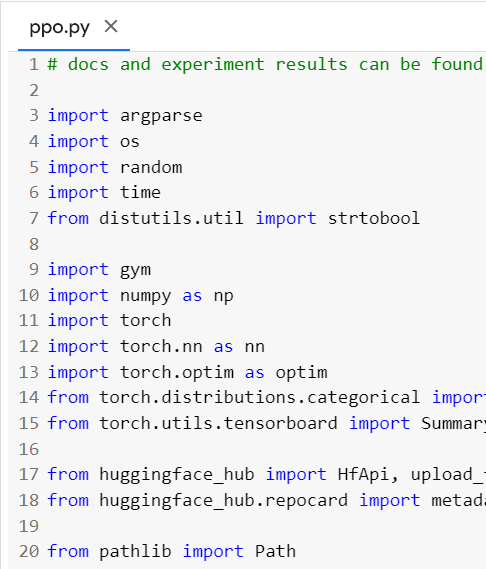
import argparse
import os
import random
import time
from distutils.util import strtobool
import gym
import numpy as np
import torch
import torch.nn as nn
import torch.optim as optim
from torch.distributions.categorical import Categorical
from torch.utils.tensorboard import SummaryWriter
from huggingface_hub import HfApi, upload_folder
from huggingface_hub.repocard import metadata_eval_result, metadata_save

from pathlib import Path
import datetime
import tempfile
import json
import shutil
import imageio

from wasabi import Printer

msg = Printer()
def parse_args():
parser = argparse.ArgumentParser()
parser.add_argument("--exp-name", type=str, default=os.path.basename(__file__).rstrip(".py"),
help="the name of this experiment")
parser.add_argument("--seed", type=int, default=1,
help="seed of the experiment")
parser.add_argument("--torch-deterministic", type=lambda x: bool(strtobool(x)), default=True, nargs="?", const=True,
help="if toggled, `torch.backends.cudnn.deterministic=False`")
parser.add_argument("--cuda", type=lambda x: bool(strtobool(x)), default=True, nargs="?", const=True,
help="if toggled, cuda will be enabled by default")
parser.add_argument("--track", type=lambda x: bool(strtobool(x)), default=False, nargs="?", const=True,
help="if toggled, this experiment will be tracked with Weights and Biases")
parser.add_argument("--wandb-project-name", type=str, default="cleanRL",
help="the wandb's project name")
parser.add_argument("--wandb-entity", type=str, default=None,
help="the entity (team) of wandb's project")
parser.add_argument("--capture-video", type=lambda x: bool(strtobool(x)), default=False, nargs="?", const=True,
help="weather to capture videos of the agent performances (check out `videos` folder)")
parser.add_argument("--env-id", type=str, default="CartPole-v1",
help="the id of the environment")
parser.add_argument("--total-timesteps", type=int, default=50000,
help="total timesteps of the experiments")
parser.add_argument("--learning-rate", type=float, default=2.5e-4,
help="the learning rate of the optimizer")
parser.add_argument("--num-envs", type=int, default=4,
help="the number of parallel game environments")
parser.add_argument("--num-steps", type=int, default=128,
help="the number of steps to run in each environment per policy rollout")
parser.add_argument("--anneal-lr", type=lambda x: bool(strtobool(x)), default=True, nargs="?", const=True,
help="Toggle learning rate annealing for policy and value networks")
parser.add_argument("--gae", type=lambda x: bool(strtobool(x)), default=True, nargs="?", const=True,
help="Use GAE for advantage computation")
parser.add_argument("--gamma", type=float, default=0.99,
help="the discount factor gamma")
parser.add_argument("--gae-lambda", type=float, default=0.95,
help="the lambda for the general advantage estimation")
parser.add_argument("--num-minibatches", type=int, default=4,
help="the number of mini-batches")
parser.add_argument("--update-epochs", type=int, default=4,
help="the K epochs to update the policy")
parser.add_argument("--norm-adv", type=lambda x: bool(strtobool(x)), default=True, nargs="?", const=True,
help="Toggles advantages normalization")
parser.add_argument("--clip-coef", type=float, default=0.2,
help="the surrogate clipping coefficient")
parser.add_argument("--clip-vloss", type=lambda x: bool(strtobool(x)), default=True, nargs="?", const=True,
help="Toggles whether or not to use a clipped loss for the value function, as per the paper.")
parser.add_argument("--ent-coef", type=float, default=0.01,
help="coefficient of the entropy")
parser.add_argument("--vf-coef", type=float, default=0.5,
help="coefficient of the value function")
parser.add_argument("--max-grad-norm", type=float, default=0.5,
help="the maximum norm for the gradient clipping")
parser.add_argument("--target-kl", type=float, default=None,
help="the target KL divergence threshold")
parser.add_argument("--repo-id", type=str, default="ThomasSimonini/ppo-CartPole-v1", help="id of the model repository from the Hugging Face Hub {username/repo_name}")
args = parser.parse_args()
args.batch_size = int(args.num_envs * args.num_steps)
args.minibatch_size = int(args.batch_size // args.num_minibatches)
return args
def package_to_hub(
repo_id,
model,
hyperparameters,
eval_env,
video_fps=30,
commit_message="Push agent to the Hub",
token=None,
logs=None,
):
"""
Evaluate, Generate a video and Upload a model to Hugging Face Hub.
This method does the complete pipeline:
- It evaluates the model
- It generates the model card
- It generates a replay video of the agent
- It pushes everything to the hub
:param repo_id: id of the model repository from the Hugging Face Hub
:param model: trained model
:param eval_env: environment used to evaluate the agent
:param fps: number of fps for rendering the video
:param commit_message: commit message
:param logs: directory on local machine of tensorboard logs you'd like to upload
"""
msg.info(
"This function will save, evaluate, generate a video of your agent, "
"create a model card and push everything to the hub. "
"It might take up to 1min. \n "
"This is a work in progress: if you encounter a bug, please open an issue."
)
repo_url = HfApi().create_repo(
repo_id=repo_id,
token=token,
private=False,
exist_ok=True,
)
with tempfile.TemporaryDirectory() as tmpdirname:
tmpdirname = Path(tmpdirname)
torch.save(model.state_dict(), tmpdirname / "model.pt")
mean_reward, std_reward = _evaluate_agent(eval_env, 10, model)
eval_datetime = datetime.datetime.now()
eval_form_datetime = eval_datetime.isoformat()
evaluate_data = {
"env_id": hyperparameters.env_id,
"mean_reward": mean_reward,
"std_reward": std_reward,
"n_evaluation_episodes": 10,
"eval_datetime": eval_form_datetime,
}
with open(tmpdirname / "results.json", "w") as outfile:
json.dump(evaluate_data, outfile)
video_path = tmpdirname / "replay.mp4"
record_video(eval_env, model, video_path, video_fps)
generated_model_card, metadata = _generate_model_card(
"PPO", hyperparameters.env_id, mean_reward, std_reward, hyperparameters
)
_save_model_card(tmpdirname, generated_model_card, metadata)
if logs:
_add_logdir(tmpdirname, Path(logs))
msg.info(f"Pushing repo {repo_id} to the Hugging Face Hub")
repo_url = upload_folder(
repo_id=repo_id,
folder_path=tmpdirname,
path_in_repo="",
commit_message=commit_message,
token=token,
)
msg.info(f"Your model is pushed to the Hub. You can view your model here: {repo_url}")
return repo_url
def _evaluate_agent(env, n_eval_episodes, policy):
"""
Evaluate the agent for ``n_eval_episodes`` episodes and returns average reward and std of reward.
:param env: The evaluation environment
:param n_eval_episodes: Number of episode to evaluate the agent
:param policy: The agent
"""
episode_rewards = []
for episode in range(n_eval_episodes):
state = env.reset()
step = 0
done = False
total_rewards_ep = 0
while done is False:
state = torch.Tensor(state).to(device)
action, _, _, _ = policy.get_action_and_value(state)
new_state, reward, done, info = env.step(action.cpu().numpy())
total_rewards_ep += reward
if done:
break
state = new_state
episode_rewards.append(total_rewards_ep)
mean_reward = np.mean(episode_rewards)
std_reward = np.std(episode_rewards)
return mean_reward, std_reward
def record_video(env, policy, out_directory, fps=30):
images = []
done = False
state = env.reset()
img = env.render(mode="rgb_array")
images.append(img)
while not done:
state = torch.Tensor(state).to(device)
action, _, _, _ = policy.get_action_and_value(state)
state, reward, done, info = env.step(
action.cpu().numpy()
)
img = env.render(mode="rgb_array")
images.append(img)
imageio.mimsave(out_directory, [np.array(img) for i, img in enumerate(images)], fps=fps)
def _generate_model_card(model_name, env_id, mean_reward, std_reward, hyperparameters):
"""
Generate the model card for the Hub
:param model_name: name of the model
:env_id: name of the environment
:mean_reward: mean reward of the agent
:std_reward: standard deviation of the mean reward of the agent
:hyperparameters: training arguments
"""
metadata = generate_metadata(model_name, env_id, mean_reward, std_reward)
converted_dict = vars(hyperparameters)
converted_str = str(converted_dict)
converted_str = converted_str.split(", ")
converted_str = "\n".join(converted_str)
model_card = f"""
# PPO Agent Playing {env_id}
This is a trained model of a PPO agent playing {env_id}.
# Hyperparameters
"""
return model_card, metadata
def generate_metadata(model_name, env_id, mean_reward, std_reward):
"""
Define the tags for the model card
:param model_name: name of the model
:param env_id: name of the environment
:mean_reward: mean reward of the agent
:std_reward: standard deviation of the mean reward of the agent
"""
metadata = {}
metadata["tags"] = [
env_id,
"ppo",
"deep-reinforcement-learning",
"reinforcement-learning",
"custom-implementation",
"deep-rl-course",
]
eval = metadata_eval_result(
model_pretty_name=model_name,
task_pretty_name="reinforcement-learning",
task_id="reinforcement-learning",
metrics_pretty_name="mean_reward",
metrics_id="mean_reward",
metrics_value=f"{mean_reward:.2f} +/- {std_reward:.2f}",
dataset_pretty_name=env_id,
dataset_id=env_id,
)
metadata = {**metadata, **eval}
return metadata
def _save_model_card(local_path, generated_model_card, metadata):
"""Saves a model card for the repository.
:param local_path: repository directory
:param generated_model_card: model card generated by _generate_model_card()
:param metadata: metadata
"""
readme_path = local_path / "README.md"
readme = ""
if readme_path.exists():
with readme_path.open("r", encoding="utf8") as f:
readme = f.read()
else:
readme = generated_model_card
with readme_path.open("w", encoding="utf-8") as f:
f.write(readme)
metadata_save(readme_path, metadata)
def _add_logdir(local_path: Path, logdir: Path):
"""Adds a logdir to the repository.
:param local_path: repository directory
:param logdir: logdir directory
"""
if logdir.exists() and logdir.is_dir():
repo_logdir = local_path / "logs"
if repo_logdir.exists():
shutil.rmtree(repo_logdir)
shutil.copytree(logdir, repo_logdir)
def make_env(env_id, seed, idx, capture_video, run_name):
def thunk():
env = gym.make(env_id)
env = gym.wrappers.RecordEpisodeStatistics(env)
if capture_video:
if idx == 0:
env = gym.wrappers.RecordVideo(env, f"videos/{run_name}")
env.seed(seed)
env.action_space.seed(seed)
env.observation_space.seed(seed)
return env
return thunk
def layer_init(layer, std=np.sqrt(2), bias_const=0.0):
torch.nn.init.orthogonal_(layer.weight, std)
torch.nn.init.constant_(layer.bias, bias_const)
return layer
class Agent(nn.Module):
def __init__(self, envs):
super().__init__()
self.critic = nn.Sequential(
layer_init(nn.Linear(np.array(envs.single_observation_space.shape).prod(), 64)),
nn.Tanh(),
layer_init(nn.Linear(64, 64)),
nn.Tanh(),
layer_init(nn.Linear(64, 1), std=1.0),
)
self.actor = nn.Sequential(
layer_init(nn.Linear(np.array(envs.single_observation_space.shape).prod(), 64)),
nn.Tanh(),
layer_init(nn.Linear(64, 64)),
nn.Tanh(),
layer_init(nn.Linear(64, envs.single_action_space.n), std=0.01),
)
def get_value(self, x):
return self.critic(x)
def get_action_and_value(self, x, action=None):
logits = self.actor(x)
probs = Categorical(logits=logits)
if action is None:
action = probs.sample()
return action, probs.log_prob(action), probs.entropy(), self.critic(x)
if __name__ == "__main__":
args = parse_args()
run_name = f"{args.env_id}__{args.exp_name}__{args.seed}__{int(time.time())}"
if args.track:
import wandb
wandb.init(
project=args.wandb_project_name,
entity=args.wandb_entity,
sync_tensorboard=True,
config=vars(args),
name=run_name,
monitor_gym=True,
save_code=True,
)
writer = SummaryWriter(f"runs/{run_name}")
writer.add_text(
"hyperparameters",
"|param|value|\n|-|-|\n%s" % ("\n".join([f"|{key}|{value}|" for key, value in vars(args).items()])),
)
random.seed(args.seed)
np.random.seed(args.seed)
torch.manual_seed(args.seed)
torch.backends.cudnn.deterministic = args.torch_deterministic
device = torch.device("cuda" if torch.cuda.is_available() and args.cuda else "cpu")
envs = gym.vector.SyncVectorEnv(
[make_env(args.env_id, args.seed + i, i, args.capture_video, run_name) for i in range(args.num_envs)]
)
assert isinstance(envs.single_action_space, gym.spaces.Discrete), "only discrete action space is supported"
agent = Agent(envs).to(device)
optimizer = optim.Adam(agent.parameters(), lr=args.learning_rate, eps=1e-5)
obs = torch.zeros((args.num_steps, args.num_envs) + envs.single_observation_space.shape).to(device)
actions = torch.zeros((args.num_steps, args.num_envs) + envs.single_action_space.shape).to(device)
logprobs = torch.zeros((args.num_steps, args.num_envs)).to(device)
rewards = torch.zeros((args.num_steps, args.num_envs)).to(device)
dones = torch.zeros((args.num_steps, args.num_envs)).to(device)
values = torch.zeros((args.num_steps, args.num_envs)).to(device)
global_step = 0
start_time = time.time()
next_obs = torch.Tensor(envs.reset()).to(device)
next_done = torch.zeros(args.num_envs).to(device)
num_updates = args.total_timesteps // args.batch_size
for update in range(1, num_updates + 1):
if args.anneal_lr:
frac = 1.0 - (update - 1.0) / num_updates
lrnow = frac * args.learning_rate
optimizer.param_groups[0]["lr"] = lrnow
for step in range(0, args.num_steps):
global_step += 1 * args.num_envs
obs[step] = next_obs
dones[step] = next_done
with torch.no_grad():
action, logprob, _, value = agent.get_action_and_value(next_obs)
values[step] = value.flatten()
actions[step] = action
logprobs[step] = logprob
next_obs, reward, done, info = envs.step(action.cpu().numpy())
rewards[step] = torch.tensor(reward).to(device).view(-1)
next_obs, next_done = torch.Tensor(next_obs).to(device), torch.Tensor(done).to(device)
for item in info:
if "episode" in item.keys():
print(f"global_step={global_step}, episodic_return={item['episode']['r']}")
writer.add_scalar("charts/episodic_return", item["episode"]["r"], global_step)
writer.add_scalar("charts/episodic_length", item["episode"]["l"], global_step)
break
with torch.no_grad():
next_value = agent.get_value(next_obs).reshape(1, -1)
if args.gae:
advantages = torch.zeros_like(rewards).to(device)
lastgaelam = 0
for t in reversed(range(args.num_steps)):
if t == args.num_steps - 1:
nextnonterminal = 1.0 - next_done
nextvalues = next_value
else:
nextnonterminal = 1.0 - dones[t + 1]
nextvalues = values[t + 1]
delta = rewards[t] + args.gamma * nextvalues * nextnonterminal - values[t]
advantages[t] = lastgaelam = delta + args.gamma * args.gae_lambda * nextnonterminal * lastgaelam
returns = advantages + values
else:
returns = torch.zeros_like(rewards).to(device)
for t in reversed(range(args.num_steps)):
if t == args.num_steps - 1:
nextnonterminal = 1.0 - next_done
next_return = next_value
else:
nextnonterminal = 1.0 - dones[t + 1]
next_return = returns[t + 1]
returns[t] = rewards[t] + args.gamma * nextnonterminal * next_return
advantages = returns - values
b_obs = obs.reshape((-1,) + envs.single_observation_space.shape)
b_logprobs = logprobs.reshape(-1)
b_actions = actions.reshape((-1,) + envs.single_action_space.shape)
b_advantages = advantages.reshape(-1)
b_returns = returns.reshape(-1)
b_values = values.reshape(-1)
b_inds = np.arange(args.batch_size)
clipfracs = []
for epoch in range(args.update_epochs):
np.random.shuffle(b_inds)
for start in range(0, args.batch_size, args.minibatch_size):
end = start + args.minibatch_size
mb_inds = b_inds[start:end]
_, newlogprob, entropy, newvalue = agent.get_action_and_value(
b_obs[mb_inds], b_actions.long()[mb_inds]
)
logratio = newlogprob - b_logprobs[mb_inds]
ratio = logratio.exp()
with torch.no_grad():
old_approx_kl = (-logratio).mean()
approx_kl = ((ratio - 1) - logratio).mean()
clipfracs += [((ratio - 1.0).abs() > args.clip_coef).float().mean().item()]
mb_advantages = b_advantages[mb_inds]
if args.norm_adv:
mb_advantages = (mb_advantages - mb_advantages.mean()) / (mb_advantages.std() + 1e-8)
pg_loss1 = -mb_advantages * ratio
pg_loss2 = -mb_advantages * torch.clamp(ratio, 1 - args.clip_coef, 1 + args.clip_coef)
pg_loss = torch.max(pg_loss1, pg_loss2).mean()
newvalue = newvalue.view(-1)
if args.clip_vloss:
v_loss_unclipped = (newvalue - b_returns[mb_inds]) ** 2
v_clipped = b_values[mb_inds] + torch.clamp(
newvalue - b_values[mb_inds],
-args.clip_coef,
args.clip_coef,
)
v_loss_clipped = (v_clipped - b_returns[mb_inds]) ** 2
v_loss_max = torch.max(v_loss_unclipped, v_loss_clipped)
v_loss = 0.5 * v_loss_max.mean()
else:
v_loss = 0.5 * ((newvalue - b_returns[mb_inds]) ** 2).mean()
entropy_loss = entropy.mean()
loss = pg_loss - args.ent_coef * entropy_loss + v_loss * args.vf_coef
optimizer.zero_grad()
loss.backward()
nn.utils.clip_grad_norm_(agent.parameters(), args.max_grad_norm)
optimizer.step()
if args.target_kl is not None:
if approx_kl > args.target_kl:
break
y_pred, y_true = b_values.cpu().numpy(), b_returns.cpu().numpy()
var_y = np.var(y_true)
explained_var = np.nan if var_y == 0 else 1 - np.var(y_true - y_pred) / var_y
writer.add_scalar("charts/learning_rate", optimizer.param_groups[0]["lr"], global_step)
writer.add_scalar("losses/value_loss", v_loss.item(), global_step)
writer.add_scalar("losses/policy_loss", pg_loss.item(), global_step)
writer.add_scalar("losses/entropy", entropy_loss.item(), global_step)
writer.add_scalar("losses/old_approx_kl", old_approx_kl.item(), global_step)
writer.add_scalar("losses/approx_kl", approx_kl.item(), global_step)
writer.add_scalar("losses/clipfrac", np.mean(clipfracs), global_step)
writer.add_scalar("losses/explained_variance", explained_var, global_step)
print("SPS:", int(global_step / (time.time() - start_time)))
writer.add_scalar("charts/SPS", int(global_step / (time.time() - start_time)), global_step)
envs.close()
writer.close()
eval_env = gym.make(args.env_id)
package_to_hub(
repo_id=args.repo_id,
model=agent,
hyperparameters=args,
eval_env=gym.make(args.env_id),
logs=f"runs/{run_name}",
)
|